Open standard · Apache 2.0
FLUID.
Federated · Layered · Universal · Instructional · Declarative.
The open-source enterprise data protocol for the agentic era.
30-second compile
Validate. Plan. Apply. Done.
$ pip install data-product-forge
Successfully installed data-product-forge-0.7.3

$ fluid validate contract.fluid.yaml
✓ schema  ✓ semantics  ✓ policy

$ fluid plan contract.fluid.yaml
Plan: 4 to add, 2 to change, 0 to destroy. plan-binding: 7f8a...

$ fluid apply contract.fluid.yaml
Bound. Applied. Verified. Published. Done in 28s.
“ The robot starves. Or worse, it makes dangerous mistakes — because it's operating on unreliable information.
The six pillars
F · L · U · I · D · ★
Federated Ownership
Domain experts own their data. Accountability lives where the knowledge lives.
Labeled & Discoverable
Rich metadata. Agents find it, understand it, trust it.
Unifying Standards
Common protocols across domains, without constraining what each domain builds.
Instructional & Self-Service
Every product is self-documenting. No one needs to ask what it is.
Declarative
Declare the outcome. The compiler does the rest.
Data as Product
Defined owner, contract, version, SLO, support. Treated like a product.
Three tiers · Data-Mesh-aligned
SDP → ADP → CDP.
Source-aligned → Aggregate → Consumer-aligned. Bound to the FLUID contract.
Raw with context
SDP
Source-aligned
Ingested directly from a source system. Lineage and metadata attached at entry.
Composable
ADP
Aggregate
Domain-cleaned, entity-resolved, contract-bound. The building blocks.
Purpose-built
CDP
Consumer-aligned
Designed for a specific business outcome. Agent-ready by default.
iAPIs
Agents can read this.
Intelligent Agentic Protocol Interfaces. Not a conventional API — a semantic interface agents understand by intent, not just by name. Discover, evaluate, act — no human in the loop.
The compiler
Eleven stages.
Cryptographically bound.
fluid generate ci emits a parameterised pipeline for any CI system. Apply refuses tampered plans.
bundle
Snapshot the contract + dependencies.
validate
Schema, semantics, policy gate.
generate-artifacts
DDL, dbt, IAM, policy.
validate-artifacts
Each artifact passes its native check.
diff
Resource-by-resource delta vs current state.
plan
Deterministic plan with crypto plan-binding.
🔒 plan-bindingapply
Mode-aware execution. Refuses tampered plans.
🔒 plan-bindingpolicy-apply
Native IAM bindings emitted.
verify
Quality + freshness contracts asserted.
publish
Catalog publish; consumers notified.
schedule-sync
DAG push to the chosen scheduler.
FLUID Command Center Early access
Forge them with the CLI.
Run them in the Command Center.
The runtime companion to forge-cli. Where deployed data products live, get discovered, get governed, and get observed.
Marketplace
Browse industry-tested blueprints. Install with one command. Forge yours from the same template.
Catalog
Live inventory of every data product running in your enterprise — with lineage, quality metrics, and SLAs.
Governance
Declarative agentPolicy gates, access bindings, and compliance trails — applied at runtime, not at audit time.
Analytics
Per-product, per-domain, per-agent. Know what every product costs and what every agent consumes.
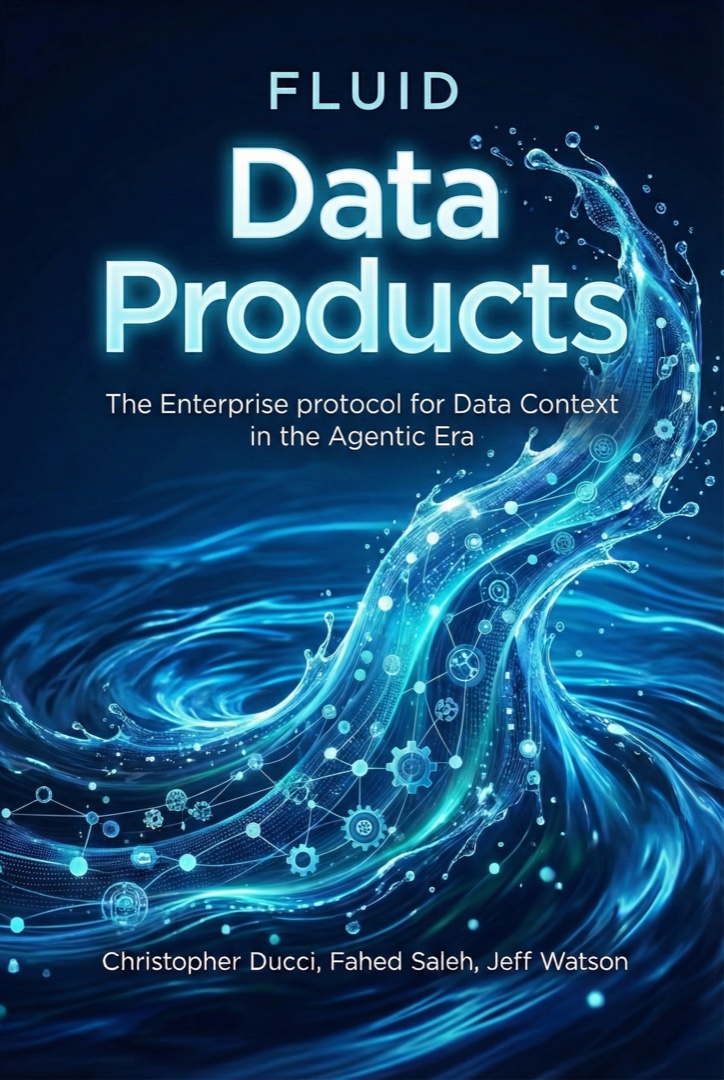
The book
The thinking behind the standard.
Before forge-cli, before the Command Center — there was the argument. FLUID lays it out in full: why enterprise data starves AI agents, and the architecture that finally feeds them. The field guide for everyone rebuilding their data foundation for the agentic era.
Open standard.
Open compiler. Open invitation.
A standard only has value if it's widely adopted.